Showing posts with label North Korea. Show all posts

Friday, July 20, 2018

America in the Claws of the Russian Bear: Clarity After Helsinki from Internationally Renowned Authority on Russian Foreign Policy, Dr. Stephen J. Blank


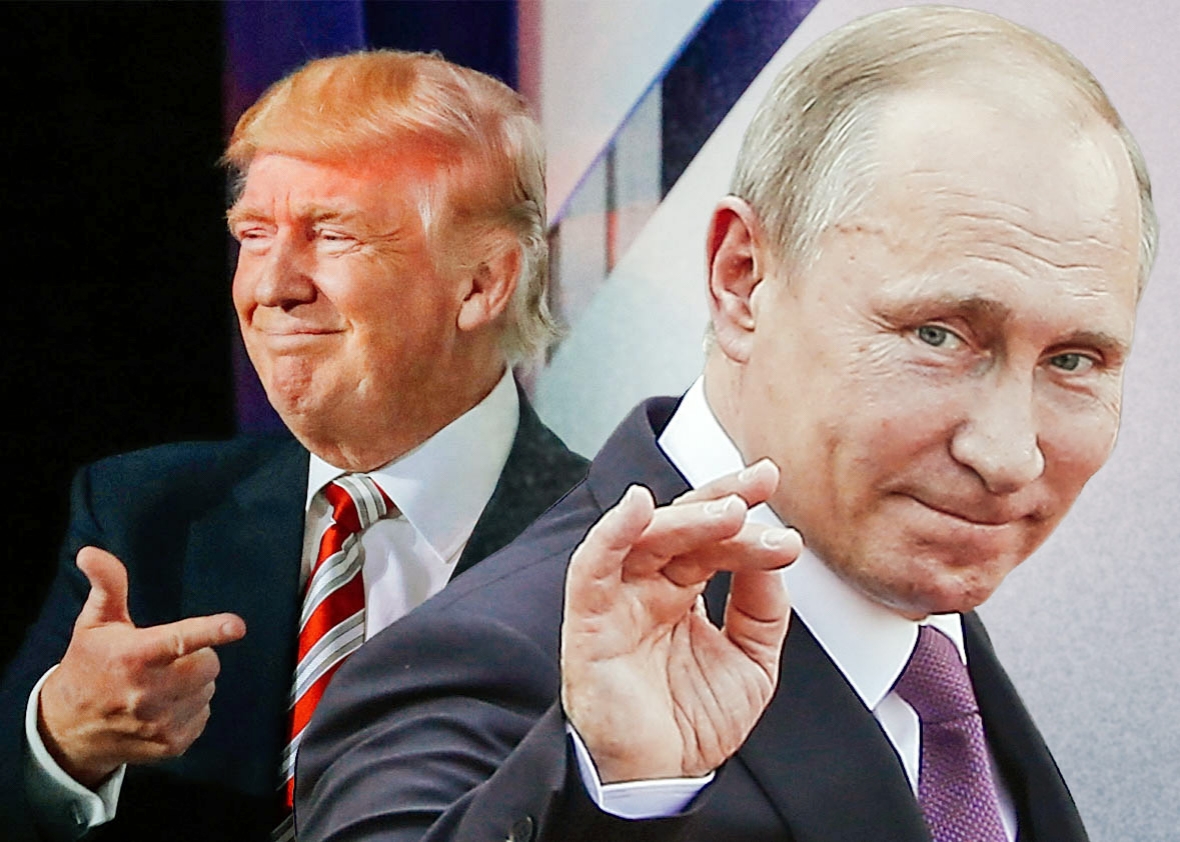
Photo Credit: Slate.com 

Last week in our pre-summit interview, the venerable Dr. Stephen J. Blank set realistic expectations for the issues to be raised by U.S. President Donald Trump and the responses and rhetoric likely to come from Russian President Vladimir Putin at their July 16, 2018 summit in Finland.  The themes explored in our interview presaged the hazards and disconnects that contributed to the catastrophe in Helsinki - and that is no surprise to those who follow Dr. Blank.  (https://securiitybriefs.blogspot.com/2018/07/calibrating-expectations-for-trump.html)  He is a University of Pennsylvania and University of Chicago-educated historian of the Russian tsarist, Soviet and post-communist eras and has a breadth and depth of insight that is second to none among the world's analysts of Russian foreign policy and the implications for U.S.-Russia relations and international security more broadly.  He served for twenty-plus years as a Professor of National Security Studies at the U.S. Army War College and today is Senior Fellow at the American Foreign Policy Council in Washington, D.C.  Having studied and travelled extensively across the former USSR and with a professional command of the Russian language, Stephen Blank is a meticulous analyst of Russian events, players and policies and his encyclopedic knowledge of things Russian and stellar assessments have him speaking to civilian and military audiences across the Americas, Europe, Asia and the Middle East.

I am honored to represent Steve Blank for speaking engagements and welcome him to my interview chair at historic moments like this - the debacle that was President Trump's performance in Helsinki and the conquest that was Vladimir Putin's.  I met with Steve again on Wednesday in his Washington, D.C. office under the weight of unprecedented disappointment in Monday's events.  As ever, he synthesized that which was brought to bear from the history, personalities and dynamics that got us to this somber point in U.S.- Russia relations.  One by one, or taken as a whole, the clips below escort us from the surreal that was Helsinki to the most practical security realities facing America today - and for the foreseeable future - in dealing with the bear that is Russia ruled by Vladimir Putin.


American Presidents come and go every four or eight years and Vladimir Putin seems to take advantage of this cycle and each President's palpable eagerness to improve U.S.-Russia relations.  What are likely to be Putin's next moves to project or expand Russian influence given his strategic objectives and his read and play of POTUS 45?


Last Friday the U.S. Department of Justice issued its indictment charging twelve Russians with a "sustained effort" to hack Democrats' emails and the Democratic National Committee's computers.  (https://www.justice.gov/file/1080281/download)  All twelve Russian nationals charged were members of the GRU - the Russian military intelligence service.  Why was the GRU deployed for this mission?


How likely is Vladimir Putin to take President Trump's whitewashing of Russian interference in the 2016 election as license to begin cyber-interference and even disruption of other U.S. systems and activities - say banking and financial services, media and/or communications? 

 
It's well documented that many who trespass against Vladimir Putin find themselves or their reputations assassinated.  As we Americans and our allies strain to understand President Trump's embrace of President Putin, is it out of the question that he [President Trump] and/or his beloved Czech-American and Slovenian-American children are under threat from the Kremlin?  


At Monday's press conference in Helsinki, Vladimir Putin reported that he spoke with President Trump about U.S. and Russian cooperation to combat the threat of "transnational crime."  With Russia so deeply involved in sex-trafficking across Eastern Europe, illegal drug and arms running in South America, identity theft and disinformation campaigns in North America and Europe, what is his motive for suggesting this?  It's as brazen and bizarre as his offer to co-investigate the hacking of the DNC - or is it? 


You've served for decades as a consultant to companies and governments on Russian and Eurasian energy matters.  Put Nord Stream 2 in perspective as a matter of international security. 


How is it that German Chancellor Angela Merkel is so comfortable with her country's reliance on Russian-supplied energy given her history with Vladimir Putin in particular and Russia and the former Soviet Union general?


What do individual and institutional investors need to keep in mind regarding Gazprom and other Russian energy companies? 


At the press conference following the private meeting on Monday between Presidents Trump and Putin there was mention of their discussions about banning weapons in space.  Beyond the Outer Space Treaty to which the United States, the Chinese and Russia (former USSR) are all signatories, what is Putin gaming for here besides the appearance of "great power status?" 
 

Realistically, where can U.S. - Russia relations go from here and how do we get there?


Notes: 
"Kompromat" is Russian for "compromising material"- that is information that could be used to damage the reputation of a public figure, create negative publicity for a politician or for blackmail of an individual.  Kopromat is held by Russian agents to ensure loyalty. 
 
Angela Merkel was born and lived in East Germany throughout and until the end of the Cold War and the reunification of East and West Germany in 1990.  Vladimir Putin served as an agent of the KGB in East Germany from 1985 until the fall of the Berlin Wall in 1989. 
 
 
Lisa Bernard is the President of SecuritySpeak, LLC, a consulting firm devoted to matters of international security.  Experts like Dr. Stephen J. Blank offer briefings, talks and distinguished lectures to audiences of all types working to bring analyses and understanding of security matters to people in all walks of life.  To secure Dr. Blank for your next program reach out to  (203) 293-4741 or LisaBernard@SecuritySpeak.net.   Learn more at  www.SecuritySpeak.net and follow us www.Facebook.com/PodiumTime.


Monday, June 11, 2018

The Trump-Kim Summit: Possibilities & Parameters Given the Personalities in Play


When word of a possible summit between U.S. President Donald Trump and North Korean Supreme Leader Kim Jong Un was announced, I took a momentary step back from the daunting issues associated with the North Korean nuclear build-up to look at the two individuals creating this historic event.  A few facts about them put them in an exclusive club.  Both men are sons of fathers who cast long shadows across the family enterprises.  Each man is married to a younger, empirically beautiful and stylish woman.  They each have young children.  Both live in palatial homes and enjoy the trappings of great wealth.  Both are viewed cautiously by the world at large and their bombast and inflammatory rhetoric have left many aghast and some even scared given the military arsenals they command.  Add to that the nearly forty-year age difference and it begs the question, "Is it possible that a 'paternal' or even 'grand-paternal' dynamic between the elder President Trump, age 71, and his junior partner Supreme Leader Kim, age 34, could frame or influence their interpersonal dynamic and help them move us out of the nuclear danger zone?" 

Of course it is possible that President Trump and Supreme Leader Kim will enter the same room and engage in that uniquely human activity of recognizing that the time has come to do what is both practical and radical and right all at the same time - that all the military preparation, economic imperatives, political dynamics - and the fatigue and fears factors that accompany them - will synthesize into a fresh and clear shared vision.  We can certainly hope so.  But personal chemistry is one of those non-quantifiable factors that can be assessed by historians and analysts only after the fact.  In the hours before these men meet, we must return to the realities that brought us to this point in the first place.  This reminds me of the question I posed in April to Gordon G. Chang, author of NUCLEAR SHOWDOWN: North Korea Takes on the World, as plans for a summit were being explored.  His response:

 
That said, he went on to share:


Time will tell, as the adage goes.  And so we wait - with all eyes on Singapore for history of some kind to be made.
 

Lisa Bernard is the President of SecuritySpeak, LLC, a consulting firm and speakers bureau devoted to matters of national, cyber and international security.  Experts in these areas offer reports, briefings, talks and distinguished lectures to audiences of all types working to bring understanding of security matters to people in all walks of life.  To host a speaker or arrange for a consultation call (203) 293-4741 or email LisaBernard@SecuritySpeak.net.  See more of their work at  www.SecuritySpeak.net and at  www.Facebook.com/PodiumTime.


Wednesday, May 9, 2018

Might "China Fatigue" Be a Factor for Kim Jong Un as the Supreme Leader Prepares to Meet President Trump in a Historic Summit?

Photo Credit: Daily Star

Twice in as many months we've learned of secret and surprise meetings between North Korea's Supreme Leader Kim Jong Un and China's President Xi Jinping, the more recent of which is taking place at the time of this writing and on the very day that U.S. President Donald Trump announced that a date and a venue have been decided for this historic Trump-Kim Summit.  This reminds me of the question I posed last month to Gordon G. Chang, author of NUCLEAR SHOWDOWN: North Korea Takes on the World, as plans for a summit were being explored.  I wanted to know if Kim Jong Un is aware of America's unique history and knack for turning enemies into prosperous and protected allies - Japan as the most obvious in North Korea's purview.  And, if so, how this might factor in to Kim Jong Un's thinking now that the major power heads of state are American President Trump for no more than two or six years, Russian President Putin for the foreseeable future and Chinese President Xi Jinping for life.  Could the narrow window of opportunity to "make a deal" with POTUS 45 be compelling to Kim?  His response:


Lisa Bernard is the President of SecuritySpeak, LLC, a consulting firm and speakers bureau devoted to matters of national, cyber and international security.  Experts in these areas offer reports, briefings, talks and distinguished lectures to audiences of all types working to bring understanding of security matters to people in all walks of life.  To host a speaker or arrange for a consultation call (203) 293-4741 or email LisaBernard@SecuritySpeak.net.  See more of their work at  www.SecuritySpeak.net and at  www.Facebook.com/PodiumTime.     


Thursday, April 19, 2018

Regional Security Concerns and North Korea's Short and Intermediate-range Systems Weigh-in Heavily as President Trump Prepares for Historic Summit


Clear from President Trump's press conference yesterday is that his approach to his summit with North Korean Supreme Leader Kim Jong Un is holistic and sensitive to the distinct concerns of American allies on and beyond the theater of the Korean Peninsula.  While the United States is vulnerable to North Korea's intercontinental ballistic missiles, allies like South Korea and Japan are vulnerable to the regime's increasingly mobile and precise short and intermediate-range rockets.  A curious addition to the North Korean arsenal was spotted on February 8th of this year at the Pre-Olympics Military Parade in Pyongyang.  Carried on hinged Transporter-Erector-Launchers (TELs - pictured below) was what appeared to be a variant of the Russian Iskander missile, perhaps now solid-fuelled for a faster, longer range and more agile version.  Any enhanced "shoot and scoot" capability for the North Koreans is particularly troubling to South Korea and worrisome for Japan.

Photo Credit: The Diplomat

It's been more than two months since the photo-op for for this new missile - dubbed the "Juche-Iskander" for it's distinctly North Korean innovations or renovations of the Russian prototype.  But we still don't know if this rocket is short or intermediate-range as it has not been flight-tested.  I wondered if this was part of Kim Jong Un's conciliatory pause in missile testing in advance of the Trump-Kim Summit or if there was something else in play.  I asked as much of Gordon G. Chang, author of Nuclear Showdown: North Korea Takes on the World, in my interview with him on April 14, 2018.  He replied:


I then pressed him to address the concerns in the context of the Trump-Kim Summit about this smaller and possibly non-nuclear missile that has military strategists concerned - beyond the worry of the damage it could do when priced-right and sold by North Korea in the global marketplace.  He responded:


More from my interview with Gordon Chang will be posted in advance of the Trump-Kim Summit.  In the interim, I urge you to follow him @GordonGChang and read his articles at www.TheDailyBeast.com.  See him live if you can or hear him on radio on The John Batchelor Show on 770 AM in the greater New York City area.  His talks, commentary and analyses are timely and cutting edge.
 
 Photo Credit: Lydia Chang
 
Lisa Bernard is the President of SecuritySpeak, LLC, a consulting firm and speakers bureau devoted to matters of national, cyber and international security.  Experts in these areas offer reports, briefings, talks and distinguished lectures to audiences of all types working to bring understanding of security matters to people in all walks of life.  To host a speaker or arrange for a consultation call (203) 293-4741 or email LisaBernard@SecuritySpeak.net.  See more of their work at  www.SecuritySpeak.net and at  www.Facebook.com/PodiumTime.   


Saturday, April 14, 2018

Chemical Weapons in Syria: The North Korean Connection


This morning I was on my way to interview Gordon G. Chang on the upcoming Trump-Kim Summit when I heard the Pentagon briefing and commentaries on the strikes on Syrian chemical weapons arsenals.  Chief Spokeswoman Dana White emphasized that this operation was different from the 2017 strike on Syria's Shayrat Air Base in that it targeted Bashar al-Assad's production capability rather than his delivery vehicles.  General McKenzie detailed the contributions of British and French forces and noted that Russian air defenses were not deployed.  The European Union called on Russia and Iran to help stop future chemical weapons attacks by the Syrian government.  What I did not hear or read in any of the reports or analyses is the role of North Korea in the Syrian chemical weapons program.  Gordon Chang is the author of Nuclear Showdown: North Korea Takes on the World and a leading authority on North Korean, Chinese and regional military and security affairs.  On the eve of the 2016 Presidential election I heard him deliver a briefing entitled, The New Nuclear Nexus: China, Iran and North Korea. In it, he revealed the eye-opening extent of North Korea's strategic relationships with other autocratic regimes.  I jumped at the chance to ask him about the relationship between North Korea and Syria with respect to chemical weapons.  His response:


My full interview with Gordon Chang will be posted in advance of the Trump-Kim Summit.  In the interim, I urge you to follow him @GordonGChang and read his articles at www.TheDailyBeast.com.  See him live if you can or hear him on radio on The John Batchelor Show on 770 AM in the NY area.  His talks, commentary and analyses are always timely and cutting edge. 
 
 
Lisa Bernard is the President of SecuritySpeak, LLC, a consulting firm and speakers bureau devoted to matters of national, cyber and international security.  Experts in these areas offer reports, briefings, talks and distinguished lectures to audiences of all types working to bring understanding of security matters to people in all walks of life.  To host a speaker or arrange for a consultation call (203) 293-4741 or email LisaBernard@SecuritySpeak.net.  See more of their work at  www.SecuritySpeak.net and at  www.Facebook.com/PodiumTime.  Very special thanks go to Lydia and Gordon Chang for their ever-gracious efforts to keep the level of discourse on these critical issues at a high and dignified plane and to the Charles Dillon Public Library for providing the venue for Lisa Bernard's interview of Gordon Chang. 


Thursday, October 5, 2017

Ground Zero: North Korea as the First Rogue Member of the Nuclear Club - An Interview with Dr. Paul Bracken, Leading International Security Strategist


Amid natural disasters of unprecedented magnitude, a man-made nightmare lurks in the North Korean nuclear program.   Not given to drama, exaggeration or panic, it was my mission to reality-check my understanding of the threat Kim Jong Un’s arsenal and his intentions pose to the stability of the North Korean Peninsula, the vulnerability of our allies South Korea and Japan, and the security of the west coast of the United States.  To this end, I interviewed Dr. Paul Bracken, author of the The Dynamics of the Second Nuclear Age:  Strategy, Dangers and the New Power Politics and Fire in the East: The Rise of Asian Military Power and the Second Nuclear Age and The Command and Control of Nuclear Forces.   Paul Bracken’s assessments are distinctly comprehensive.  He holds a B.S. in Engineering from Columbia University and a Ph.D. in Operations Research from Yale University.   A Professor of Political Science and Operations Management, his grasp of the technology, history, players and politics – and the interplay of them all – is second to none.  War gaming under conditions of stress and uncertainty is what Paul Bracken does for private industry and the United States military.  What the games reveal about human nature, conflict escalation, and exogenous factors that alter strategic plans is surprising, sobering and instructive.  The following are excerpts from our talk.
BERNARD: Seismic tests support the North Korean claim that it tested a hydrogen bomb, however "sniffers" - the aircraft that fly through debris - have not detected radiation levels consistent with such a nuclear explosion.  How much of this claim is hype from North Korean State Media? 
 
BERNARD:  Earlier in 2017 you reasoned that Kim Jong Un would make the development of an H-bomb a top priority.  Suddenly, within just months, that goal may well have been realized.  What accounts for the lightening-pace of the North Korean nuclear program? 

 
BERNARD:  Of the nine states in the world that are nuclear-armed, North Korea is the one over which analysts and practitioners of foreign policy are losing sleep.  What is so troubling here?

BERNARD:  Citizens voice their worries about the rhetoric coming from President Trump towards Kim Jong Un during this crisis.  What do you make of the President's remarks? 
BERNARD:  We've seen the Trump administration's management of this challenge via the United Nations and the U.S. Congress with economic sanctions and through Secretary of State Tillerson's talks with Chinese and Japanese leaders.  What would American leadership look like for this crisis and on nuclear (non) proliferation in general?

BERNARD: Where is the United States in terms of modernizing our aging nuclear arsenals and committing to strategic thinking and planning for this second nuclear age?

 
BERNARD:  As we wrap up, it feels befitting to share an excerpt of an interview I read at the outset of my research.  Asked about your first reaction to the ongoing dispute with North Korea you replied:  "Stanley Kubrick (Dr. Strangelove) had no imagination.  Five years ago (2011, as Obama was going to eliminate nuclear weapons from the world), if anyone said a nuclear poker game would play out between 'The Donald' and Kim Jong-un, no one - no one - would have believed it.  Well, here we are ...."  Thank you for your generosity with your time, candor and expertise.  

Paul Bracken is available for formal presentations and distinguished lectures via Lisa Bernard's SecuritySpeak, LLC.  (203) 293-4741.  LisaBernard@SecuritySpeak.net.  Learn more about him at www.SecuritySpeak.net.  


Friday, October 21, 2016

Just After Reports of Another North Korean Ballistic Missile Test ...

My followers began asking for clarity from an expert on the relationship between China and North Korea's nuclear program.  I asked Gordon Chang, author of Nuclear Showdown: North Korea Takes on the World, and internationally respected pundit on security matters in Asia, about this.


With his comprehensive approach and gracious style, Gordon Chang is renowned for his incisive analyses and commentary.  He lived and worked in Shanghai as Counsel to the American law firm Paul Weiss, and earlier in Hong Kong as Partner in the international law firm Baker & McKenzie.  He has briefed the United States CIA, Pentagon and State Department on security developments and he shared this assessment with me this week:

"North Korea has three launchers--theTaepodong-2, the KN-08, and KN-14--that can hit the lower 48 states.  The better view is that the North cannot mate a nuclear warhead to them, but that is only a matter of about three years.  The North Koreans have already put a nuke on top of their intermediate-range Nodong.

Beijing could rein in North Korea, but Chinese leaders do not want to do so because they view America as their main strategic rival.  They find Kim Jong Un's antics useful in keeping us and our allies off balance. 

We could force Beijing into being helpful--by, for example, imposing secondary sanctions on Chinese banks and enterprises--but so far there have been only tentative moves to do so.  The U.S. sanctions on Dandong Hongxiang industrial, imposed last month, show attitudes in the American capital are changing.  They are changing because an unstable Kim Jong Un in control of the world's most destructive weapons is presenting American policymakers with little choice."

N.B. Gordon Chang will be presenting The New Nuclear Politics: China, Iran and North Korea, at the Election Night 2016 Security Summit, 80 Minutes Around the World: Security Briefings for the Next American President, in Westport, CT, on November 8th.


Saturday, April 2, 2016

As Washington Hosts World Leaders at the Nuclear Security Summit ...


I asked Dr. Paul Bracken, author of the tour de force book, The Second Nuclear Age: Strategy, Danger and New Power Politics, for a comment. He replied:
 
 
The pace of military technology has reached a level not seen since the cold war in the 1950s.  Drones, cyber-war, targeted killings, anti-satellites weapons, hypersonic missiles are coming into the forces not just of the United States but of many countries.  Add to this atomic weapons, and soon, hydrogen bombs for India, Pakistan, Israel, and North Korea.  We are entering a new world of technology, yet the old political order of nation states remains essentially unchanged.  The 2016 Nuclear Security Summit shows the growing tension of a political order that is out of phase with technology advances.  Something has to give, and I don't think it's going to come from a slowdown in technology.
 
 
Scroll down for video of Dr. Bracken speaking to the North Korean missile program, STEM, emerging technologies and other key topics in security.

Sunday, February 14, 2016

Talking with Paul Bracken: Today's and Tomorrow's Technologies, Developments and Dangers in the Nuclear Arena

It was grey and cold outside when I arrived at Yale University to sit in on Dr. Paul Bracken’s class, Strategy, Technology & War, but illuminating and warm in his classroom.  There, eighty-five coeds and grad students from around the world (selected from hundreds who seek registration) engaged in a back and forth about strategy and the function of nuclear weapons from the Cold War into this “the second nuclear age.”  That is also the title of Dr. Bracken’s tour de force book, The Second Nuclear Age:  Strategy, Danger and the New Power Politics, a clarion-call for policymakers, technologists, investors and industrialists about this precarious era of nuclear proliferation.  It was just a few days after the North Korean missile launch when I arrived at the School of Management and I was percolating with questions for Dr. Bracken which he graciously addressed in our interview after class.  I am happy to bring the highlights to you in this space. 

Lisa Bernard:  Just this weekend, North Korea successfully launched a long range missile – a provocation deemed so serious that the United Nations Security Council convened an emergency session.   In what context can we understand this?
 
Lisa Bernard:  A recent article in the Wall Street Journal, The Other Dangers from That North Korean Nuke Test, by Messrs. Gilinsky and Sokolski, describes a frightening development, namely, the increasingly available advanced technologies and materials for hastened and state-of-the-art nuclear weapons development.  What does this mean, practically speaking, for the proliferation of WMD - weapons of mass destruction? 
 
Lisa Bernard:  We are coming upon the twentieth anniversary of STEM and the tenth anniversary of President George W. Bush’s American Competitiveness Initiative to bolster STEM.  With a B.S. in Engineering, a Ph.D. in Operations Research, as a Professor of Political Science and Business and a consultant to various branches of the U.S. government, you are uniquely positioned to view the impact of these efforts.  Professor Bracken, what do you see?


Lisa Bernard:  Paul, you speak and write so insightfully about the symbiotic relationship between Silicon Valley and the Pentagon.  Given the dynamics of national security today, what do you think might we see come out of Silicon Valley in the next chapter of their connection?
 
 
Lisa Bernard:  The gravity of these matters is sobering - even overwhelming. Thank you for helping me help my audience gain some perspective on the news we hear and the realities we face.  Your time and sharing of your expertise is very much appreciated. 


Would you like to host Paul Bracken and continue this conversation at your organization?  Call me at (203) 293-4741 or email LisaBernard@SecuritySpeak.net.  I’d be happy to help you through the particulars and arrangements.