Showing posts with label Middle East. Show all posts

Thursday, May 10, 2018

Understanding the Solid Relationship Between Israel and Russia

 
Photo Credit: The Times of Israel

This week marks the 73rd anniversary of the defeat of German Nazism and Israeli Prime Minister Benjamin Netanyahu was in Moscow with Russian President Vladimir Putin to mark the occasion.  Their diplomatic relationship - and the larger dynamic of Israel-Russia relations - are curious to so many Americans given the Russian patronage of Iran and the enmity between Israel and Iran.  For some perspective, I put the question to Dr. Stephen J. Blank, Senior Fellow at the American Foreign Policy Council in Washington D.C.  Dr. Blank is a historian of Russian foreign and military policies and his expertise spans the tsarist, Soviet and post-communist periods.  Ever generous with his time and expertise, he shared seven key reasons for what he called "the solidity of this relationship."
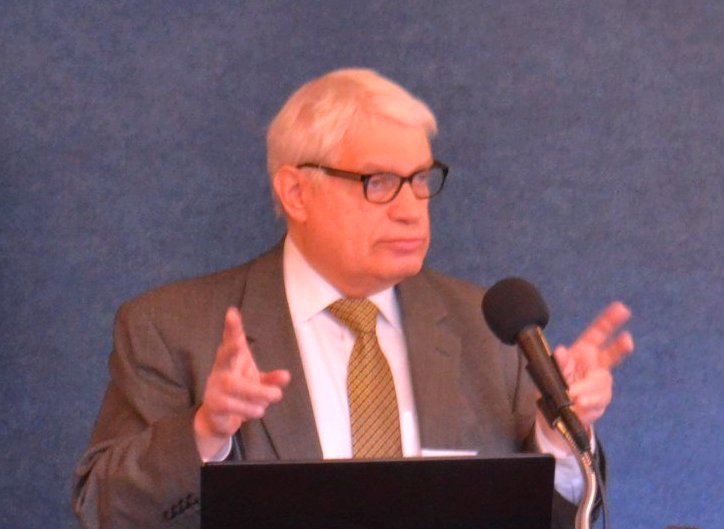
 
  • First, Putin personally appears to have good feelings about Israel and Jews and Russian policy formally eschews anti-Semitism - though there is still a fair amount of  it in society and he is willing to use it in measured doses for his domestic needs. 

  • Second,  Russian elite respect Israel's military-economic-technological prowess and know that Israel is a channel to Washington. 

  • Third, there are thriving trade and investment relations between the two countries - even to the point where Israel has sold weapons to Russia. 

  • Fourth, Israel respects Russian red lines and avoids actions that are provocative to her. If Israel has to cross a line it informs Moscow first.  This is something Putin et al. appreciate because it shows Israeli respect for Russian sensitivities and interests. 

  • Fifth, Moscow knows that wars against Israel end badly for Arabs and bring the U.S. back into the Middle East in a big way. 

  • Sixth,  there is some belief that the Russian Aliyah - the group of Russian Jews who have settled in and become citizens of Israel - is in some sense "our people" and they wish to preserve that tie.  They also understand what the USSR lost by pursuing anti-Semitic policies. 

  • Seventh, it is critical to Moscow's Middle East policies and its sense of those policies that it be able to talk candidly to all parties and not be excessively identified with any one state's interests.  This also includes Israel precisely because of the many unsettled security issues in the region."

In hearing Dr. Blank's incisive comments I am reminded of the salient and sage words of another distinguished alumnus of University of Pennsylvania, Charles Dudley Warner, who observed that "[p]olitics makes strange bedfellows." 

Lisa Bernard is the President of SecuritySpeak, LLC, a consulting firm devoted to matters of international security.  Experts like Dr. Stephen J. Blank offer briefings, talks and distinguished lectures to audiences of all types working to bring analyses and understanding of security matters to people in all walks of life.  To secure a speaker for your program reach out to  (203) 293-4741 or LisaBernard@SecuritySpeak.net.   Learn more at  www.SecuritySpeak.net. 


Wednesday, January 3, 2018

DEMOCRACY: Stories from the Long Road to Freedom by Condoleezza Rice, Earns its Place on the Permanent Bookshelf


DEMOCRACY: Stories from the Long Road to Freedom by Condoleezza Rice, 482 pp. published by Twelve, an imprint of Grand Central Publishing, May 2017. Hardcover ISBN: 978-1-4555-4018-1. Ebook ISBN: 978-1-4555-4019-8. Signed edition ISBN: 987-1-5387-5997-4. $35.00 U.S. Available on Amazon. 

Hands down, this is my choice for the 2017 contribution to our understanding and pursuit of security. Citizen, scholar, CEO or policymaker, this long lens survey of emergent, maturing and failed democracy in nine countries and regions across the world provides both food for thought and frames of reference for the numerous news alerts, political hiccups and trickles of information that come at us constantly.  If you want a handle on the conundrum of Russian democracy, it is yours in a chapter that is as compelling a read about personalities and proclivities as it is analytical and instructive.  If you are baffled by the paucity of official support for the ninety two percent of Kurds who voted for independence from Iraq in September 2017, Dr. Rice's chapter on the Middle East will provide you an appreciation for their catch-22 of competence, resources and geography.  And if you feel swept up in, or swept aside by, the divisiveness in American politics, the very first chapter makes the case that the perfection of democracy in the U.S. has consistently been inconsistent, imperfect, sometimes violent, rarely smooth and yet, remarkably stable for the institutions the Founders built.  In a word, there's something here for everyone and the organization of this comprehensive work makes for easy access to one's interests.


Within these 450+ pages is an appraisal of a concept articulated in four of Condoleezza Rice's compelling voices - as an authoritative analyst, advocate, raconteur and enthusiast.  Through her  scholarship at Stanford University and her empirical observations as U.S. National Security Advisor and U.S. Secretary of State, we see that there are elastic expressions of democracy beyond the American experience.  Democracy has taken hold across cultures and countries whose histories contain no hint of democratic philosophy or behavior.  We see the areas of the world where varying degrees, experiments, emulations and aspects of democracy as we know it are in progress; witness the 2010 elections in Iraq and the 2010 promulgation of a constitution in Kenya.  And we see how regional stability and security are enhanced for the presence of democratic nations.  On page 432, Dr. Rice declares

There is both a moral and practical case for democracy promotion.  In the long arc of history, we know that democracies don't fight each other.  The "democratic peace" is observable.  No one today is sorry that the United States helped build a democratic Germany and Japan after World War II.  Both had been aggressors against their neighbors and there was no guarantee that they would not be again.  Neither country had sustained experience with democracy and it took time  for institutions to take root.  But we stood alongside them, and now they help to form the foundation for international peace and prosperity.

There is a vitality about this work that grips us spiritually and emotionally as well as intellectually.  Portions read like a memoir as Condoleezza Rice's own journey is, in and of itself, a testament to the dynamics of American democracy - from her childhood in segregated Alabama, to her studies in the former Soviet Union, to her professorship at Stanford, to her service as the first black woman in the posts of U.S. National Security Advisor and U.S. Secretary of State.  And her personal passages inform her investigation.  Her keen assessments and the reality checks they suggest are present from the start.  On page ten she debunks what she refers to as "the myth of democratic culture" and asserts

No nationality or ethnic group lacks the DNA to come to terms with this paradox. Over the years, many people have tried to invoke "cultural explanations" to assert that some societies lack what it takes to establish or sustain democracy. But this a myth that has fallen to the reality of democracy's universal appeal ... It was once thought that Latin Americans were more suited for caudillos than presidents; that Africans were just too tribal; that Confucian values conflicted with the tenets of self-rule. Years before that Germans were thought to be too martial or too subservient, and - of course - the descendants of slaves were too "childlike" to care about the right to vote ... Those racist views are refuted by stable democracies in places as diverse as Chile, Ghana, South Korea and across Europe ....


Flowing through the brain food in this keeper are personal anecdotes that burrow deep into our hearts.  They remind us that there are real people behind the democratic institutions and the procedural outcomes that make news - human beings and their stories that tell the big picture of the progress for humanity that democracy alone nurtures and protects.  These anecdotes offer us reasons for patience and perspective on the timetable of democracy's progress.  From the Epilogue:

Years later, sitting in our first meeting with Prime Minister Tony Blair, I was heartened by something he said: "I look at the two of you and I ask whether this could happen in Great Britain. And I say, not just yet." He was referring to the African American secretary of state, Colin Powell, and the African American national security advisor, Condi Rice, sitting on either side of the president of the United States ... Blair was not the only one to notice. President Lula daSilva of Brazil talked to me about America's journey. "I wanted to be sure to have Afro-Brazilians in my cabinet," he said. Upon taking office, he named four to his cabinet, as well as the first to the Supreme Court ... These were times when America's own democratic journey sent a positive message ... And then there was Ben Franklin looking down on us from the magnificent portrait painted by David Martin in 1767. What would old Ben think of this? I thought silently as President Bush made remarks. Then, Ruth Bader Ginsburg - a Jewish woman and Supreme Court Justice - asked me to raise my hand. "I do solemnly swear to protect and defend the Constitution of the United States ....

In the United States, the 2016 elections were catalytic to fierce debates, demonstrations and revelations concerning the endurance, integrity and dependability of our American institutions of democracy.  In a post scriptum entitled "2016," Dr. Rice succinctly separates out the issues, concerns and trends in not only the U.S. but in other mature democracies.  In her characteristic humility and clarity she offers a compass for moving forward smartly and sensitively.  Whether you read this book in your professional stead or for your personal enrichment, "2016" is a solid place to start.

Lisa Bernard is the President of SecuritySpeak, LLC, a consulting firm devoted to matters of national, cyber and global security and crisis management. Experts in these areas offer briefings, talks and distinguished lectures to audiences of all types working to bring unbiased analyses and understanding of security matters to people in all walks of life. (203) 293-4741. www.SecuritySpeak.net. 

Monday, September 25, 2017

Weary of Myopic TV News Coverage of International Affairs? Welcome i24NEWS with Less Politics and More Reportage

Check out i24NEWS on Optimum TV or on the web at i24NEWS.tv.   Broadcasting in English, Arabic and French, this television news station covers global affairs with an emphasis on events across the Middle East.  I've noticed it covers stories unreported by other outlets and it's analysis segments DEBRIEF with Nurit Ben, and STRICTLY SECURITY with Barbara Opall-Rome, feature  experts with refreshingly frank, easy-to-understand and timely insights. 


Wednesday, December 23, 2015

Putin in Play?


Stephen Blank, Ph.D.
I had the pleasure of interviewing internationally known Russia specialist, Dr. Stephen Blank, now a Senior Fellow at the American Foreign Policy Council in Washington, D.C., and previously a Professor of National Security Studies at the U.S. Army War College.  I’ve known Steve for many years and worked with him at Foreign Affairs Speakers Bureau.  I welcome him today to my interview chair.
BERNARD:  Steve, help me understand  … When we see Russian President Putin playing a leadership role with the destruction of chemical weapons in Syria, the bombing campaign against ISIS, the incursion into Ukraine and his deepening relationship with Iran, the old Cold Warrior in me senses an imperialist mission.    On the other hand, knowing how ailing the Russian economy and the Russian defense industry are, I see a clever and greedy tactician whose weapons systems sales make money for him and his cronies.   Which is it – Putin as a Peter the Great-type strategist expanding the Russian empire or Putin the opportunistic capitalist seizing markets for his military wares?
BLANK:  To answer this question it is essential to grasp that there is no necessary contradiction between strategy and tactics.  Only in the U.S. media and political class, neither of whom grasp the difference between the two and use the terms promiscuously, does it seem that Putin is just a tactician and not necessarily a good one.  To be sure, Russia has incurred serious and unexpected costs that will be long lasting.  But from Putin’s perspective, which is the only that counts for him, he has won.  Crimea is his, Eastern Ukraine is under his control and the Ukrainian state is severely crippled and enduringly vulnerable to myriad Russian pressures –both military and non-military.  In Syria the supposed isolation of Russia has been shown to be a myth.  The Obama Administration acknowledges that Russia must be part of an overall Middle East solution and has caved in on letting Assad stay in power because it has no strategy to counter Russia.  Meanwhile, despite rising financial costs of the operation, Putin has a working coalition with Iran while U.S. alliances are collapsing. Putin, in my view (to be fair many would disagree), is a strategist, the quality of the strategy is another issue) but his strategic goals do not exclude a superb sense of opportunistic timing.
BERNARD:  Steve, reports are consistent that Putin is not bombing ISIS targets in Syria but instead the opponents of Bashar al-Assad.   What’s your take on what is really happening between Putin and ISIS and Putin and Assad?   And what does this suggest for the United States?
BLANK:  What this suggests for the U.S. is that the Administration still fails to grasp what Putin is up to or to support the development of the analytical capabilities we need to understand Russia.  It points to serious defects in intelligence and policymaking and to the continuing absence in this administration of any real understanding of strategy or how limited military forces may be used to advance concrete political interests and objectives.  If we are to deal with the multiple challenges facing us – not just Putin’s Russia – these problems must be rectified sooner rather than later.
Although Putin now calls for improved ties with Washington he has indeed attacked other factions much more seriously and often than ISIS because Putin’s goals have nothing to do with ISIS other than keeping it in Syria where its members cannot threaten Russia, as would be the case in the North Caucasus and potentially Central Asia.  Putin stands foursquare behind Assad and the U.S. still has no clear idea what it wants.  Moreover, despite years of experience to the contrary, Washington still seems entranced by the idea that a “third force,” neither Assad nor ISIS, can come to power in Syria, establish itself as the legitimate rule through some semblance of democratic rule and be pro-Western.  This, to be frank, is delusional and explains much of the failure to date.
BERNARD:   It’s curious how Vladimir Putin seems to have a solid working relationship with Israeli Prime Minister Benjamin Netanyahu at the same time he deepens his relationship with the Ayatollah Khomeini in Iran – having just sold him S-300 surface-to-air missiles – a sophisticated missile defense system.   On the heels of the Iranian nuclear agreement, how are the U.S. and Israel to understand this?  
BLANK:  Russia has several reasons for close ties with Israel.  It does not want a new Arab-Israel war even if everyone else was at peace for the Arabs would lose and Washington would dominate the political aftermath.  Second, it trades substantially with Israel and is now very interested in getting into Israel’s energy policies to gain another source of leverage in the Middle East.  At the same time it supports a unified Palestinian camp and will not recognize Hamas and Hezbollah as terrorists.  Indeed, acting through Iran and Damascus, Moscow is one of their principal suppliers of weapons though it claims those groups are not terrorists!  More recently it clearly sees an opportunity to score points at Washington’s expense given the incompetence on both sides that has led to serious Israel-American tensions.  Putin and Netanyahu appear to understand each other.  Putin respects Israel’s willingness to use force and is personally not an anti-Semite (though perfectly willing to play that card at home if necessary).  These factors explain the improved ties with Russia.
BERNARD:  Thank you, Steve, for your time, expertise and candor.  To see Steve Blank's extensive professional profile, visit www.LisaBernardsSecuritySpeak.com and to host him, contact me directly at Lisa@LisaBernardsSecuritySpeak.com.